Tuesday, April 28, 2015

Welcome to Summer Reading 2015!

Warning! Actual book may be larger...
We're working hard behind the scenes and counting down the days to the start of our adult summer reading program: Big Book Challenge 2015: Anna Karenina. We'll be using this blog to post our reactions to the book, cool information that we might come across, and selected thoughts from each discussion. Can't make it to a discussion, or just want to share your thoughts? Feel free to comment! We're looking forward to an interesting and thought-provoking summer.

Planning to participate? Please let us know using this link: https://www.surveymonkey.com/r/TS6P7RY.  Join us May 27th, from 5-7 pm, for a kick-off celebration.


Sunday, September 7, 2014

Middlemarch Tweets Again

Thanks for participating in our discussion this summer! If you missed the final discussion, or just want to know what others talked about, here's another collection of tweets.


Thursday, August 28, 2014

Thursday afternoon discussion

We had eight participants and a cookie cake for the Thursday Middlemarch wrap-up.

Favorite characters:
Celia, Mary. Was Rosamund as bad as some of us seem to think. She did tell Dorothea that she, herself, meant nothing to Ladislaw. Was that noble or self-serving?


Wednesday, August 27, 2014

Favorite Characters and Favorite Books

Besides the major characters, we had votes for Bulstrode,
Celia, and Lydgate's French girlfriend (the actress who admitted killing her first husband)

Four participants said that Middlemarch is (or is now) there favorite book of all time.
Seven participants said that Middlemarch is their favorite book of the "Big Books of Summer"
Five said that War and Peace was their favorite.
Two each for Les Miserables and Don Quixote.

Characters

How important are Fred and Mary to the story?

Is Lydgate the other main character of the book, besides Dorothea?

Is Fred and Mary's marriage the combination of the self-centered group of characters and the more altruistic? Are they the hope for the future?

Is this about the art of the possible?


Several Recommendations for the BBC's version of Middlemarch

Check our catalog for
Middlemarch on DVD at the Library

The last Wednesday discussion of Middlemarch

We have about forty people on hand for the first discussion on the final part of Middlemarch. A lot of discussion about the  "Key to All Mythologies."

Tuesday, August 26, 2014

As our discussions approach, a few questions:

·         What is the significance of the nature of Casaubon’s work A Key to all Mythologies?  If Casaubon’s abortive magnum opus had been, say, a survey of soil composition in England, how would that have affected the novel?

·         Jerome Thale in The Novels of George Eliot (Columbia University Press, 1959) writes “Aspiration in Middlemarch is both noble and ridiculous.”  Is this valid?  What aspirations do the many different characters have?


·         In Jennifer Uglow’s George Eliot (Virago, 1987), she points out that Eliot poses the question “why we never tire of  ‘telling over and over again how a man comes to fall in love with a woman and be wedded to her, or else be fatally parted from her’ yet are comparatively uninterested in an intellectual passion like Lydgate’s?”  What is your answer for Eliot?

·         The last sentence of Middlemarch:
“But the effect on those around her was incalculably diffusive: for the growing good of the world is partly dependent on unhistoric acts; and that things are not so ill with you and me as they might have been, is half owing to the number who lived faithfully a hidden life, and rest in unvisited tombs.”  Of this, Rebecca Mead (My Life in Middlemarch) says, “A vein of melancholy runs through the sentence.”  Do you agree?


Monday, August 25, 2014

Unfamiliar words and phrases

One encounters many unfamiliar words and phrases in Middlemarch, partly because of the passage of time since it was written, and partly because of Eliot's formidable erudition. But there is one mysterious term I can clear up right away.

On page 776 of our edition, Celia says, "But see, here is my unclemin cog." Baffled, I went to the same page in the Oxford edition, where she says, "But see, here is my uncle coming."

It's just a misprint.
 - David Linzee

Monday, August 11, 2014

The Publication of Middlemarch

At the last Wednesday discussion, someone again asked about the original publication of Middlemarch. We know it was released in a serial format, like many of Dickens' works, but how did that come about? Finding myself curious to know the answer, I went looking.

Like any good question, finding the answer often leads to more questions, as well as information that is almost more interesting than the answer you were originally looking for. Having only read the brief biography printed in our discussion guide (bad librarian!), I quickly discovered that Mary Ann Evans (or Marian, as she preferred to be called later in life) was something of an anomaly, especially for her time. She first got her start writing for the Coventry Herald, her local newspaper. But it was after meeting John Chapman that she got her first big break in 1850 writing a review for the Westminster Review. She then moved to the Strand area of London the following year to help Chapman with his publishing business and to start a career of freelance writing. After several months of ups and downs mostly related to the fact that the married Chapman was carrying on an affair with her and another woman, and all three women in his life were living under the same roof, she returned to Coventry. Not long after this (and after a reportedly horrible conversation with Chapman), she returned to the Strand to work as an assistant editor at the Westminster Review (without being credited, of course). With Chapman as the public face of the editorship of the magazine, Marian did most of the work, and by all reports, did a damn good job at it. It was around this time that she met George Henry Lewes.
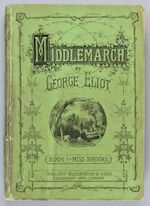
A fellow writer, Lewes was married, but already on the outs with his wife when he met Marian. They eventually fell in love, and she moved in with him. It was at this time that she decided to write fiction, starting with Scenes from a Clerical Life. Lewes and Marian decided to send the first part to Blackwood's Magazine for publishing. John Blackwood was a friend of Lewes', and after a few back and forths, agreed to publish (under the name George Eliot) the first part without seeing the rest. This was the start to a beautiful publishing relationship. For Middlemarch, Lewes and Marian decided they wanted to find a different way to publish. At that time, the predominant way to sell a novel was in three parts, known as a three-decker or triple-decker, and through a circulating library like the one Charles Mudie ran. Mudie, though, wanted major discounts in order to publish and sell books through his library, which was something that Blackwood, Lewes, and Marian wanted to avoid. It was Lewes who came up with the idea to publish Middlemarch "in half-volume parts at intervals of one, or as I think better, two months" (Pool 201). With this mode of publishing in place, Middlemarch became the eight-part book that we know. It also turned out to be a great way to publish, as many readers waited with bated breath for the next part to come out.

So there you have it. The release of Middlemarch was unconventional for its time, just like its author. In my search, I also came across this article, "Going to Middlemarch", which looks at the history of the novel, especially as it pertains to its focus as a historical novel. It includes some interesting information on Marian's life. Most of the information used in this post was found in the biography George Eliot: The Last Victorian (check our catalog) by Kathryn Hughes, and in the book Dickens' Fur Coat and Charlotte's Unanswered Letters: the Rows and Romances of England's Great Victorian Novelists by Daniel Pool (check our catalog). I also came across this auction listing from Bonhams (also where I got the photo from) - an original set of Middlemarch that went for $56,250. Wow!