Friday, August 28, 2015

On Closing Anna Karenina


Thanks to the Paul and Marsha for sharing this with us!

Thursday, August 27, 2015

There are 9 10 attendees at the Thursday Anna Karenina discussion at UCPL. A big finish, over the last two days, for our fifth summer read! 

  • Does Vronsky have any depth? He cares about looks, gambling, riding, art (a bit). No interior monologues to speak of.
  • Where did Vronsky get his money after he resigned his commission?
  • Why do Sergey and Varenka never re-connect? Is this another version of Vronsky and Anna, a couple not connecting? Or Kitty and Levin, who missed their connection on the first try?


 We had quite a crowd, 36 attendees, and a very lively discussion at our Wednesday night discussion about Anna Karenina.
Have you read Anna? What did you think of this book? How does Tolstoy's novel rank on your list of favorites?


 We had a great discussion on Wednesday night! Overall Anna Karenina was a hit, though it did not make the top of anyone's list (not even among the 5 Summer Reading Big-Books that we have done).


  • Is Anna a likeable character? Not for too many of us.
  • What drives Anna to suicide? Opium? Loneliness? Powerlessness?
  • Could Anna have been happy?
  • How serious was Levin about suicide? 


Monday, August 17, 2015

Snipe Hunting with Levin and Stiva

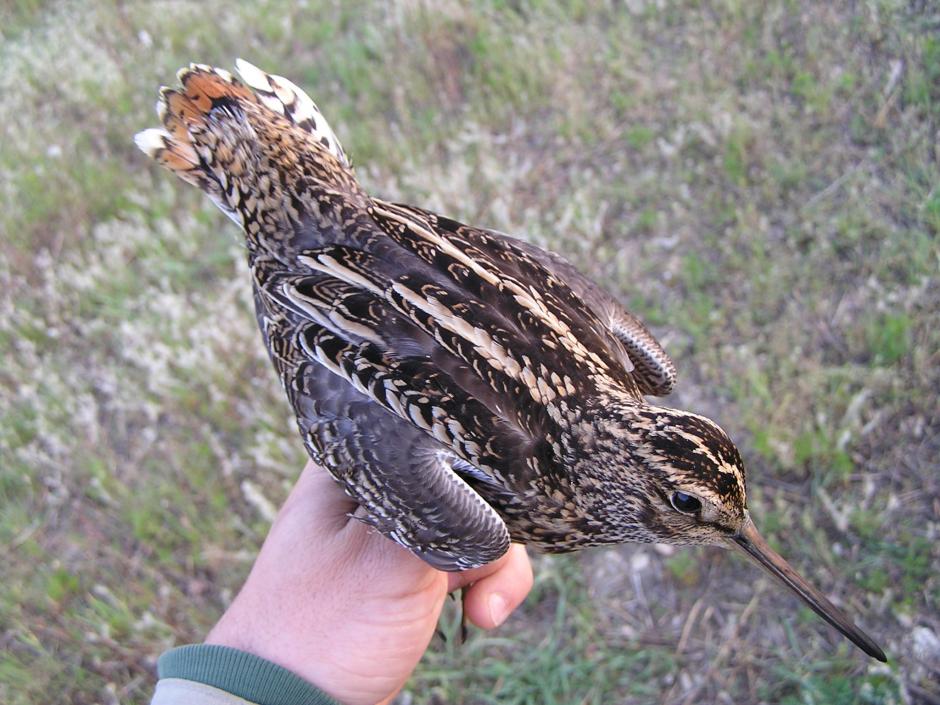
A large section of Part VI is dedicated to an overnight hunting expedition with Stiva, Levin, and Vasenka (whose name I kept misreading as Varenka, putting a new twist on that scene). The men are hunting snipe, a waterbird similar to a sandpiper that lives in Scandinavia and Western Russia.

According to the Handbook for Travellers in Russia, Poland, and Finland (published in 1865, and available online here), the snipe-hunting season started on July 15 and was over by the end of  September, at which point the weather had gotten too cold for the birds, which migrate to Africa. The same book notes that English setters were the preferable dogs for such a hunt, which often involved slogging through marshes.

Photos from the Internet Bird Collection
While reading this passage in Anna Karenina, however, I was faintly amused by the notion of snipe-hunting, which I grew up knowing as a hazing ritual for those new to outdoorsy activity. The more experienced person sends the less experienced and more gullible party out into the woods, generally late at night, with instructions to make certain noises, or do certain movements to catch a snipe (generally in a bag or pillowcase). The experienced outdoorsman then toys with the "snipe hunter" in some way, either by scaring them or just getting them hopelessly lost, and if all goes well, everyone has a good laugh about it later. (The practical joke even made its way into an episode of Cheers, when Frasier is sent on a snipe hunt. Watch a clip here.) It wasn't until I read this book for the first time a couple years ago that I realized that snipes actually exist.

Did anyone else get sent on a snipe hunt grow up with this definition?

Friday, August 14, 2015

Oh the In-laws!


I can't help but laugh while reading Part VI and feeling sorry for Levin.  He is so in love with Kitty and they are getting used to each other as a couple when the in-laws show up and show no signs of ever leaving.  Poor Levin!  His new family includes Dolly and her children who, thanks to Stiva, can't really afford to live on their own.  Varenka is visiting, Stiva is using the place as his personal vacation get-away on weekends to hunt and relax.  Stiva even shows up with an acquaintance who flirts with Kitty and throws Levin into a horrible jealousy that results in conflict between the newlyweds.

Most important is Kitty's mother who is there to supervise Kitty and restrict her movements, now that she is with child.  She insists that the birth take place in Moscow instead of at home in the country and just knows better than anyone about how things should be done.  Despite all, Levin does care for his mother-in-law but his favorite is his father-in-law "whom he liked more and more the more he saw of him..." (Section 6, Chapter 6).  You can't help but think maybe the most likable part of the old prince was the fact that Levin doesn't see him all that often.

"And I know why, " the princess went on; "he says that young people ought to be left alone for a while at first." (Section 6, Chapter 6).

Hear hear!

Tuesday, July 28, 2015

Our July Discussions!

1886 Edition
Thanks to all for a terrific series of discussions last week.  Many of your comments were tweeted and have been compiled in the previous post, below.  A few other thoughts:

  • The painting section was great - Vronsky as a dabbling aristocrat.  Either you get art or you don't.
  • The question of how to manage people is still relevant.  
  • The English aristocracy is different from the Russian - the English occasionally pretend to care about their servants, the poor, etc.
  • "Women's education gets confused with emancipation." - a favorite quote
  • Levin's brother's death is a demonstration of the differing domains of Kitty and Levin - they each have their work that they will dive into.
  • In Tolstoy's initial creation, Anna was much more fully described; she was overweight, vulgar.  In her permanent incarnation much of the psychological detail has fallen away.  Why?
  • Tolstoy is a writer who can give with one hand and take away with the other.
  • Why did Anna refuse the divorce when it was offered?  Is she wishy-washy?
  • Anna is guilty of using magical thinking (like a child...)
  • And speaking of children, Anna likes the idea of her son more than the real thing.
  • Did Vronsky really attempt to kill himself?  Did he truly want to die?
  • Lidia Ivanovna is a frenemy.
  • Nicholas Levin's partner, Marya Nikolaevna, is pushed aside when Kitty arrives.  
  • And about those moths... they are a distraction, a game, they represent decay, a predatory insect, or perhaps, Tolstoy was writing by candlelight and had moths on his mind.

Tuesday, July 21, 2015

What is with the moths?


In part four, chapter five, Karenin goes to visit a lawyer to discuss divorce.  The thing that stuck with me about that visit over anything else was the moths flying around the office.  The lawyer "with a swiftness that could never have been expected of him, opened his hands, caught the moth, and resumed his former attitude" p. 419.  The moth catching happens at least three more times in that chapter.  So, all you smart people, what is it with the moths?

Tuesday, July 14, 2015

Duels

I'm still taken with the idea of duel between Alexy Karenin and Count Vronsky.  What a great way to solve a problem...as long as you are Vronsky and feeling very confident of the outcome.  Karenin, not so devoted to this type of problem solving.  Number 1, he is a successful administrator so not accustomed to the ides of dueling as a form of negotiation.  Number 2, by my reading he seems to be an out-of-shape old man, way past the physical prime that he may or may not have once enjoyed. Number 3, even though Karenin wants things to appear "proper", he really doesn't have much "fight" in him for Anna.

Take a look at this Infographic I found that gives more information about Russian duels:

The rules and etiquette of a Russian duel

Read more: http://sputniknews.com/infographics/20120213/171286087.html#ixzz3fuO65kyK

Is anyone out there longing for the return of the duel?