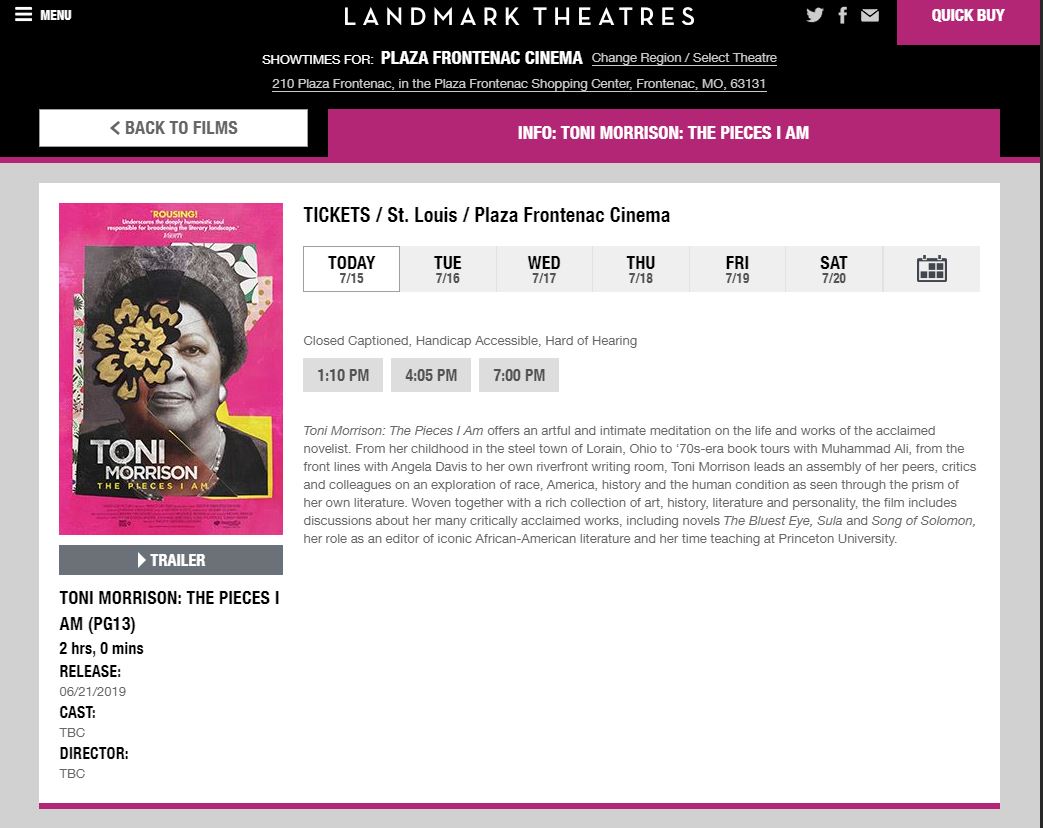
Monday, July 15, 2019

Saturday, June 29, 2019
Morrison writes of Melville

Here are
some of Toni Morrison’s thoughts on blackness in 19th century
American literature that may inform our upcoming reading of Moby Dick:
“It only seems that the canon of American literature is
“naturally” or “inevitably” white…Perhaps some of these [19th
century white American] writers have much more to say than has been
realized. Perhaps some were not so much
transcending politics, or escaping blackness, as they were transforming it into
intelligible, accessible, yet artistic modes of discourse. The reexamination of founding literature of
the United States for the unspeakable unspoken may reveal those texts to have
deeper and other meaning, deeper and other power, deeper and other
significances. One such writer, in
particular, it has been almost impossible to keep under lock and key is Herman
Melville.”
“…if the white whale is the ideology of race, what Ahab has
lost to it is personal dismemberment and family and society and his own place
as a human in the world. The trauma of
racism is, for the racist and the victim, the severe fragmentation of the self,
and has always seemed to me a cause (not a symptom) of psychosis…”
“I would not like to be understood to argue that Melville was
engaged in…simpleminded black/white didacticism, or that he was satanizing
white people…What I am suggesting is that he was overwhelmed by the
philosophical and metaphysical inconsistencies of an extraordinary and
unprecedented idea that had its fullest manifestation in his own time in his
own country, and that that idea was the successful assertion of whiteness as
ideology.”
Morrison,
Toni. The Source of Self-Regard: Selected Essays, Speeches, and Meditations.
Alfred A. Knopf., 2019.
The Bluest Eye discussions
 We had a great first round of discussions. Here are my notes, very loosely organized. Please comment and add your own thoughts!
Reactions?
Beautiful
Painful
Compelling
Great social observations of class
Who is the main character?
No way that Pecola could narrate her own story
Ensemble piece rather than Pecola as a main character
Other characters flush out the picture of Pecola - the layers build
Do we accept that Pecola is the main character? We get to know the other characters
because of her
because of her
The novel opens and closes with her - Morrison has provided these other people
to tell her story so that you can see how inevitable her undoing is
to tell her story so that you can see how inevitable her undoing is
Not so sure that there needs to be one main character - the contrast
between Claudia and Pecola is the main thing - she and her sister learn from
Pecola’s experience
between Claudia and Pecola is the main thing - she and her sister learn from
Pecola’s experience
Pecola is the main character in that everybody needed her to feel better,
either sexually, or socially or whatever
either sexually, or socially or whatever
Maureen Peal
Maureen Peal is an excellent composite of a certain type of person in the black community
How could Maureen be so hateful?
Maureen has the manipulative power and cruelty of an adult, or worse
Soaphead Church
Let’s talk about Soaphead Church - it seemed like he came out of the
blue- he is only alluded to - when Henry abuses Frieda, Claudia asks if he did it like
Soaphead -a foreshadowing
blue- he is only alluded to - when Henry abuses Frieda, Claudia asks if he did it like
Soaphead -a foreshadowing
Why is Soaphead Church in the book? He’s obviously gay and
doesn’t know what to do with it. - he’s a vehicle for Pecola’s undoing -
if you accept that Pecola is the main character,then his main role is to push
Pecola over the edge
doesn’t know what to do with it. - he’s a vehicle for Pecola’s undoing -
if you accept that Pecola is the main character,then his main role is to push
Pecola over the edge
Pecola is a thing for Soaphead - the only things he connects with are things -
he makes a thing, an instrument of Pecola
he makes a thing, an instrument of Pecola
Soaphead misquotes the Bible
Soaphead is seen by the town’s women as untouchable
Soaphead goes further than Job in chastising God - he takes God’s role
Cholly
How should we feel about Cholly
Everyone accepts that Aunt Jimmy died from peach cobbler
Morrison’s description of the old women at Chollly’s aunt’s funeral
almost sounds Buddhist - freedom from striving, fear of pain
almost sounds Buddhist - freedom from striving, fear of pain
Can Cholly be forgiven?
The line after the rape - the only sound she makes is the air coming out of a balloon
Claudia and Frieda
There were no black dolls when I was growing up - a lack of positive images
for African American women
for African American women
Claudia has conscious disdain for the standards
Difference between poverty and less poverty
Some groups need to feel that there is something lesser than they -
even though Claudia and Frieda care, they liked knowing that Pecola is beneath them
even though Claudia and Frieda care, they liked knowing that Pecola is beneath them
But - only Claudia and Frieda wanted someone to want the baby to live -
they plant the seeds, have more compassion
they plant the seeds, have more compassion
But - did they want the baby to live so that the cycle of having someone
below them could continue?
below them could continue?
Dick and Jane
The Dick and Jane text - sentences collapsed because children couldn’t
make any sense of Dick and Jane
make any sense of Dick and Jane
A falling apart of meaning - or is it a taunt
The jammed together words are like a droning that races through her brain
In the 60s the spell was beginning to be broken
Pecola
Where does it actually say the Breedloves are ugly - page 38
Reader sees ugliness as inferior
Pecola is flower that’s a weed
The Bluest Eye
Picture of a couple of places and times
The Bluest Eye has the makings of several books
She put everything into this one first book, it in fact has the makings of several novels
The gorgeous language stands out
Could be the story of many different marginalized peoples
Morrison: beauty was not simply something to behold; it was something
one could do - does this mean ‘beauty is as beauty does’
one could do - does this mean ‘beauty is as beauty does’
Idea for the blue eyes comes from: the blue-eyed little girl Pauline
takes care of, Shirley Temple, her mother’s standards of beauty
takes care of, Shirley Temple, her mother’s standards of beauty
Is the bluest eye anything that makes us feel more accepted? It could be
any other thing - what is your personal bluest eye?
any other thing - what is your personal bluest eye?
You can make a god of anything
Lots of talk about eyes and being seen and not being seen - p 48- shopkeeperdoesn’t see Pecola because for him there is nothing to see
Other topics
Why the sequence of the seasons - beginning with the autumn
The school year?
Seasons may refer to an agricultural year - Pecola has her first period
in the beginning, is impregnated, but it’s all wrong
in the beginning, is impregnated, but it’s all wrong
The prostitutes are good, the preachers are bad
At one time the St. Louis department stores would only hire light-skinned black employees
One reader identifies with the candy store scene - she has had similar experiences
This book has been in the top ten most banned books list several times in recent years
Some wonder whether today’s generation is more obsessed withmaterial possessions than color

Thursday, June 27, 2019
Thursday discussion of "The Bluest Eye"
Some of the things we discussed during the second (Thursday) meeting:
Sense of a class divide as well as race-with Geraldine, her son, Louis Junior, and Maureen Peal, along with the white characters, the Fishers and Mr. Yacobowski, all of whom look down on the rest of the characters.
The MacTeers, Frieda and Claudia and their parents, who are mostly invisible, but obviously pretty good parents
Pecola is invisible and has no sense of self, everyone else sees her as ugly and she is willing to accept the role
Recommended reads from members of the group:
Fire Shut Up in My Bones by Charles Blow
Well Read Black Girl by Glory Edim, ed.
Other key moments we discussed:
Soaphead Church and his damaged self, damaging others.
Cholly, Pecola's horrible father, experiencing first sexual experience when forced into rape.
Dick and Jane portions at the start of the chapters, with normal spacing at first and then eventually running together, showing disintegration, this is the way the world is supposed to be. Reading Dick and Jane as a taunt.
China, Poland, and Miss Marie (the Maginot Line), in many ways the happiest and most (maybe) well adjusted characters (most honest?) in the book


Sense of a class divide as well as race-with Geraldine, her son, Louis Junior, and Maureen Peal, along with the white characters, the Fishers and Mr. Yacobowski, all of whom look down on the rest of the characters.
The MacTeers, Frieda and Claudia and their parents, who are mostly invisible, but obviously pretty good parents
Pecola is invisible and has no sense of self, everyone else sees her as ugly and she is willing to accept the role
Recommended reads from members of the group:
Fire Shut Up in My Bones by Charles Blow
Well Read Black Girl by Glory Edim, ed.
Other key moments we discussed:
Soaphead Church and his damaged self, damaging others.
Cholly, Pecola's horrible father, experiencing first sexual experience when forced into rape.
Dick and Jane portions at the start of the chapters, with normal spacing at first and then eventually running together, showing disintegration, this is the way the world is supposed to be. Reading Dick and Jane as a taunt.
China, Poland, and Miss Marie (the Maginot Line), in many ways the happiest and most (maybe) well adjusted characters (most honest?) in the book

Wednesday night:


Wednesday, June 19, 2019
Not So Much Fun with Dick and Jane

From our vantage point, it's easy to see what's problematic about these characters:
"Dick and Jane live in a suburban house surrounded by a white picket fence. Mother cheerfully does the housework. Father wears a suit to work and on weekends mows the grass and washes the car. Dick, the oldest of three, is well behaved and always in motion: bicycle-riding, kite-flying or playing fetch with Spot. His sister Jane is pretty and lighthearted and helps care for their baby sister, Sally, while never upstaging her brother. Illustrators chose her stylish and frilly wardrobe, updated about once every five years, from the catalogues of Sears, Roebuck & Company and Montgomery Ward."
(Gabriel, Trip. “`Oh, Jane, See How Popular We Are.’.” New York Times, vol. 146, no. 50569, 3 Oct. 1996, p. C1.)
More about Dick and Jane can be found at this blog.
For next week's discussion, or for commenting below, I'm wondering:
- How do you feel about Morrison's use of Dick and Jane as a frame to the novel? Is it effective?
- If you used the Dick and Jane series as a student, what are your memories?
- What are your experiences finding reading materials for children in your lives? Do you visit children's libraries or bookstores often? How difficult is it for you to find materials that you believe are meaningful for your child?
Monday, June 17, 2019
Why Black Dolls Matter
"The big, the special, the loving gift was always a big, blue-eyed Baby Doll. From the clucking sounds of adults I knew that the doll represented what they thought was my fondest wish. ... Adults, older girls, shops, magazines, newspapers, window signs—all the world had agreed that a blue-eyed, yellow-haired, pink-skinned doll was what every girl child treasured. 'Here,' they said, 'this is beautiful, and if you are on this day "worthy" you may have it."
In this passage from The Bluest Eye, young Claudia spells out why Pecola Breedlove so desperately desires blue eyes — because blue eyes, white skin, and blond hair represent the pinnacle of beauty, at least according to popular culture.
Researchers have been studying representation in dolls for ages. In 1947, Kenneth and Mamie Clark published this study, asking young African American children to pick out dolls that represent themselves, as well as to pick out dolls that they consider good and bad and that they'd most like to play with. Considered a landmark study, the findings reveal that a majority of the children associate white dolls with "good," black dolls with "bad," and continue to explain that, when asked to pick out the doll that closest represents themselves, several children broke down crying and would not choose.
There have been more black and brown dolls created and sold in the intervening years — I fondly remember cuddling with my black Cabbage Patch Kid, Vivian, and dressing up Whitney, my black Barbie doll, while my daughter has Doc McStuffins toys that she plays with. Even Disney is making strides toward diversity, introducing Tiana from The Princess and the Frog, Moana, Mulan, and Jasmine from Aladdin. But still, newer versions of the Clark study reveal the same results — both black and white children prefer white dolls to black ones, showing that systemic racism starts early.
Check out this blog post for a really great first-person account of why having dolls that look like you matters. As the author says, "All it takes is for one small thought like 'black dolls are stupid compared to white dolls' or “Superman isn’t Mexican” and little by little, you’ll start to pick apart certain things and relate them back to you."
And for those of us who are not people of color, this blog post offers an excellent reason why we not only need to make sure our kids have toys representing a variety of races and cultures, but also by supporting that with experiences and discussion.
In this passage from The Bluest Eye, young Claudia spells out why Pecola Breedlove so desperately desires blue eyes — because blue eyes, white skin, and blond hair represent the pinnacle of beauty, at least according to popular culture.
Researchers have been studying representation in dolls for ages. In 1947, Kenneth and Mamie Clark published this study, asking young African American children to pick out dolls that represent themselves, as well as to pick out dolls that they consider good and bad and that they'd most like to play with. Considered a landmark study, the findings reveal that a majority of the children associate white dolls with "good," black dolls with "bad," and continue to explain that, when asked to pick out the doll that closest represents themselves, several children broke down crying and would not choose.
There have been more black and brown dolls created and sold in the intervening years — I fondly remember cuddling with my black Cabbage Patch Kid, Vivian, and dressing up Whitney, my black Barbie doll, while my daughter has Doc McStuffins toys that she plays with. Even Disney is making strides toward diversity, introducing Tiana from The Princess and the Frog, Moana, Mulan, and Jasmine from Aladdin. But still, newer versions of the Clark study reveal the same results — both black and white children prefer white dolls to black ones, showing that systemic racism starts early.
Check out this blog post for a really great first-person account of why having dolls that look like you matters. As the author says, "All it takes is for one small thought like 'black dolls are stupid compared to white dolls' or “Superman isn’t Mexican” and little by little, you’ll start to pick apart certain things and relate them back to you."
And for those of us who are not people of color, this blog post offers an excellent reason why we not only need to make sure our kids have toys representing a variety of races and cultures, but also by supporting that with experiences and discussion.
Wednesday, June 12, 2019
The Bluest Eye...Where to Begin?
 |
| Jasmine Ward stars as Pecola at Philadelphia's Arden Theatre, 2018 |
The Library provides access to Ebsco Host, a database of both popular and scholarly periodical articles. It contains hundreds of articles on the novel; this particular one was fascinating to me:
Saunders, James Robert. “Why Losing a Tooth Matters: Shirley Jackson’s ‘The Tooth’ and Toni Morrison’s ‘The Bluest Eye.’” Midwest Quarterly, vol. 53, no. 2, Winter 2012, pp. 193–204.
To read, click on the link above and enter your U City Library card number, then click 'PDF full text' on the left side of the screen.
Some questions:
- The author points to the novel's discussion of the 'conditions' that existed which caused Pauline's tooth to rot. What conditions would those be? Are they only physical, or are they spiritual as well?
- The article author compares Pauline's lost tooth to Ahab's lost leg. Is the comparison appropriate?
- What is the connection between Pauline's tooth and the 'bluest eyes' that Pecola dreams of?
Please comment below!
Monday, June 10, 2019
Keynote Lecture Q and A
Take a look at the Q and A portion of Dr. Freeburg's talk, for answers to these and other questions:

- In your research, did you find that Melville had any intimate experience with African Americans to absorb the culture?
- Is there any symbolism for feminism that works its way into the book?
- The whalers were primarily New England stock, so how did Pip get on the boat?
- You can pair Ahab and Pip, who is African American, and Ishmael and Queequeg, who is Pacific Islander and dark-skinned. What is the reader meant to see with these pairings?
- What's the relationship between Nathaniel Hawthorne and Melville?
- How did you get interested in Melville?
And many thanks once again to Dr. Christopher Freeburg for an excellent talk!

Wednesday, June 5, 2019
Watch the keynote lecture!

We're still working on the question and answer portion of the talk, but will have that posted soon.
And as always, please comment with your thoughts!
Monday, June 3, 2019
Kickoff Lecture - Some Notes

Dr. Freeburg’s remarks included concepts from:
Melville and the Idea of Blackness: Race and Imperialism in Nineteenth Century America. New York: Cambridge, 2012. (Available in the library at 813.3 FRE.)
"Pip and the Sounds of Blackness." New Melville Studies. New York: Cambridge University Press, 2019.
My lecture notes are below. Please comment and add your thoughts!
How to put together the moments of racial conflict and angst with the philosophical issues
There are people who don’t see the racial aspects as important - Dr. Freeburg disagrees
Ideas of power: nature and the dark side of romantic reverie come to mind
Scholars of African American history overlook the workings of black experience
Presence of African art forms in Moby Dick - documenting Melville’s exposure to black art forms
What is the relationship between black expressive culture and Melville’s boldest expressive strokes
He wants to conduct an Inquiry into neglected aspects of Melville’s tour de force
Pip is a symbol of blackness himself Pip’s improvisational skats, tambourine playing, connect him to black culture
Tension between individual and communal interests
Pip and Ahab revolve around moral challenges springing from the violent pangs of isolation
Pip - the most abased of the crew will be elevated
Pip as a figure of black culture - does not fulfill any of these tropes - inarticulate impossibility - Pip physically and metaphorically points to black culture’s centrality in Moby Dick
Toni Morrison and Ralph Ellison - share a fascination with Melville
Discussion of Moby Dick Chapter 40: Midnight, Forecastle: Ring shout movement - Pip’s contribution - readers see the stakes of maintaining a diverse collection of people in the face of violence
In New York, Melville had access to black culture, also via the newspapers
Black people are described as festive and celebratory in Moby Dick
A distinctive view of moral value in Pip Ring shout picture - (Chapter 40: Midnight, Forecastle) - Pip enters the scene at the call of the French sailor - Pip’s tambourine is the foundational beat to the dance - most influential slave dance in 19th century America
The Ring Shout appealed to the ancestors or the gods - reverence for the divine - consecrated social space through ritualistic movement - committing to a life of living for God and for others
Collectivity over individual alienation
A moral affirmation - when the ring is broken and the group falls into a violent disarray - Pip is at the center of the moral affirmation
Melville suggests the need for intimate collaboration
Anxiety of impending doom - Pip helps him affirm that there is a right side of the fence
Castaway - Pip verifies why black cultural expression matters
If Pip is truly a coward, why doesn’t he fear Stubb enough to fall in line - we are all in the hands of the gods - Pip is an emblazoning diamond - the artist takes care to make him shine - Pip embodies heaven’s sense - and the tragic destruction of social bonds
Pip’s descent into divine madness - related to the immorality of Stubb’s choice to chase the whale instead of Pip
What about the price for the crew - they must live with the price that Pip has paid
Whiteness appears as evil in the novel, generally - but in this area it’s a comfort, beneficence - let us squeeze hands all around strong communal bonds are forged through shared affliction
Queequeg and his coffin - Pip sits there - the coffin turns into a life buoy for Ishmael - Pip will beat Queequeg’s dying march - his music makes the moment sacred
Link between Pip and Ahab - they are bonded in their madness - Ahab sucks wondrous philosophies from Pip
Development of Ahab’s madness is bound up in his relationship with Pip - the fate of the Pequod is sealed when Ahab pulls away from Pip
Pip is opposite of Frederick Douglass ...His absence of voice
Pip is Melville’s object - we only know his beautiful interiority - it is available through impressions -
Melville was shaped by black culture - black culture animates the novel’s entire moral center - he provides a forceful way to envision what it means to be black - he asks what type of life is worth living and dying for
Group Questions
Is there evidence that Melville knew a real young black person who influenced him? Ahab and Ishmael show who they are in the unfolding of their relationships with the pairs Queequeg and Pip
Queequeg is the catalyst for Ishmael’s world coming apart - as he communicates with Queequeg
You won’t get the interiority of The Bluest Eye in Moby Dick
Ishamel = what he learns is how to deal with not being able to answer the questions
Queequeg points out that the social bonds are right here - why does Ishmael want to be focused ‘out there’ - come in here, to the pairing
The black and brown characters give you the final meaning of the novel Moby Dick - Ishmael floating on Queequeg’s coffin
Whaling was a great way to evade slave catching - frequently this tactic was used
How much of what Pip represents is a criticism of middle class American life? Deep criticism of the marketplace - of capital, gain, but Melville also felt that they over- romanticized nature - Pip is the opposite of the Emerson eyeball - I can see everything but I can’t say anything
The strongest voice in Moby Dick is about people coming together
Find your own monomania - what keeps you away from other people? - that’s your Ahab
What about the dedication - to Nathaniel Hawthorne - Hawthorne and his mosses - grappling with the existential limits of thought
Melville and the Idea of Blackness: Race and Imperialism in Nineteenth Century America. New York: Cambridge, 2012. (Available in the library at 813.3 FRE.)
"Pip and the Sounds of Blackness." New Melville Studies. New York: Cambridge University Press, 2019.
My lecture notes are below. Please comment and add your thoughts!
How to put together the moments of racial conflict and angst with the philosophical issues
There are people who don’t see the racial aspects as important - Dr. Freeburg disagrees
Ideas of power: nature and the dark side of romantic reverie come to mind
Scholars of African American history overlook the workings of black experience
Presence of African art forms in Moby Dick - documenting Melville’s exposure to black art forms
What is the relationship between black expressive culture and Melville’s boldest expressive strokes
He wants to conduct an Inquiry into neglected aspects of Melville’s tour de force
Pip is a symbol of blackness himself Pip’s improvisational skats, tambourine playing, connect him to black culture
Tension between individual and communal interests
Pip and Ahab revolve around moral challenges springing from the violent pangs of isolation
Pip - the most abased of the crew will be elevated
Pip as a figure of black culture - does not fulfill any of these tropes - inarticulate impossibility - Pip physically and metaphorically points to black culture’s centrality in Moby Dick
Toni Morrison and Ralph Ellison - share a fascination with Melville
Discussion of Moby Dick Chapter 40: Midnight, Forecastle: Ring shout movement - Pip’s contribution - readers see the stakes of maintaining a diverse collection of people in the face of violence
In New York, Melville had access to black culture, also via the newspapers
Black people are described as festive and celebratory in Moby Dick
A distinctive view of moral value in Pip Ring shout picture - (Chapter 40: Midnight, Forecastle) - Pip enters the scene at the call of the French sailor - Pip’s tambourine is the foundational beat to the dance - most influential slave dance in 19th century America
The Ring Shout appealed to the ancestors or the gods - reverence for the divine - consecrated social space through ritualistic movement - committing to a life of living for God and for others
Collectivity over individual alienation
A moral affirmation - when the ring is broken and the group falls into a violent disarray - Pip is at the center of the moral affirmation
Melville suggests the need for intimate collaboration
Anxiety of impending doom - Pip helps him affirm that there is a right side of the fence
Castaway - Pip verifies why black cultural expression matters
If Pip is truly a coward, why doesn’t he fear Stubb enough to fall in line - we are all in the hands of the gods - Pip is an emblazoning diamond - the artist takes care to make him shine - Pip embodies heaven’s sense - and the tragic destruction of social bonds
Pip’s descent into divine madness - related to the immorality of Stubb’s choice to chase the whale instead of Pip
What about the price for the crew - they must live with the price that Pip has paid
Whiteness appears as evil in the novel, generally - but in this area it’s a comfort, beneficence - let us squeeze hands all around strong communal bonds are forged through shared affliction
Queequeg and his coffin - Pip sits there - the coffin turns into a life buoy for Ishmael - Pip will beat Queequeg’s dying march - his music makes the moment sacred
Link between Pip and Ahab - they are bonded in their madness - Ahab sucks wondrous philosophies from Pip
Development of Ahab’s madness is bound up in his relationship with Pip - the fate of the Pequod is sealed when Ahab pulls away from Pip
Pip is opposite of Frederick Douglass ...His absence of voice
Pip is Melville’s object - we only know his beautiful interiority - it is available through impressions -
Melville was shaped by black culture - black culture animates the novel’s entire moral center - he provides a forceful way to envision what it means to be black - he asks what type of life is worth living and dying for
Group Questions
Is there evidence that Melville knew a real young black person who influenced him? Ahab and Ishmael show who they are in the unfolding of their relationships with the pairs Queequeg and Pip
Queequeg is the catalyst for Ishmael’s world coming apart - as he communicates with Queequeg
You won’t get the interiority of The Bluest Eye in Moby Dick
Ishamel = what he learns is how to deal with not being able to answer the questions
Queequeg points out that the social bonds are right here - why does Ishmael want to be focused ‘out there’ - come in here, to the pairing
The black and brown characters give you the final meaning of the novel Moby Dick - Ishmael floating on Queequeg’s coffin
Whaling was a great way to evade slave catching - frequently this tactic was used
How much of what Pip represents is a criticism of middle class American life? Deep criticism of the marketplace - of capital, gain, but Melville also felt that they over- romanticized nature - Pip is the opposite of the Emerson eyeball - I can see everything but I can’t say anything
The strongest voice in Moby Dick is about people coming together
Find your own monomania - what keeps you away from other people? - that’s your Ahab
What about the dedication - to Nathaniel Hawthorne - Hawthorne and his mosses - grappling with the existential limits of thought
Subscribe to:
Posts (Atom)